
After years of regulatory approvals and construction, Bison Low Carbon Ventures has officially flipped the switch on commercial CO2 injection at the Meadowbrook Carbon Storage Hub near Legal, Alberta. This isn't just another announcement. The hub is actively injecting carbon dioxide into deep saline aquifers right now.
What Makes This Project a First
The Meadowbrook Carbon Storage Hub stands out as the first among Alberta's 25 CCS hub tenures to achieve full regulatory approval and begin commercial operations. This milestone came after the Alberta Energy Regulator granted D065 scheme approval in February 2025, following earlier approvals in August 2024.
Even more notable is the involvement of Marubeni Corporation, which holds an equity stake in Bison. This makes Meadowbrook the first CCS project involving a Japanese company where CO2 is collected from a third party and stored underground in exchange for injection fees. That business model could reshape how carbon storage projects get financed globally.

>> RELATED: Canada Invests in Carbon Capture and Storage in Alberta
The Numbers Behind the Hub

An overview of the key facts and figures for the Meadowbrook Carbon Storage Hub, detailing its capacity, targets, and development.
The project received its initial hub tenure in April 2022, when Bison was selected as one of six recipients during Alberta's first carbon storage hub bidding round.
Where the CO2 Is Coming From
The first carbon dioxide flowing into Meadowbrook comes from Deep Sky Alpha, a direct air capture facility in Innisfail, Alberta. That facility pulls CO2 directly from the atmosphere using multiple DAC technologies before trucking it to Bison's injection well.
This partnership creates a complete carbon removal chain: capture from the air, transport to storage, and permanent sequestration underground.
"In just one year, we went from breaking ground to pulling carbon from the sky and locking it underground for good."
Alex Petre, CEO, Deep Sky
Why Alberta Became the Testing Ground
Alberta's geology makes it ideal for carbon storage. The province sits on vast deep saline aquifers that can safely hold CO2 for centuries. Add decades of subsurface expertise from oil and gas operations, and you have a region uniquely positioned to lead in CCS deployment.
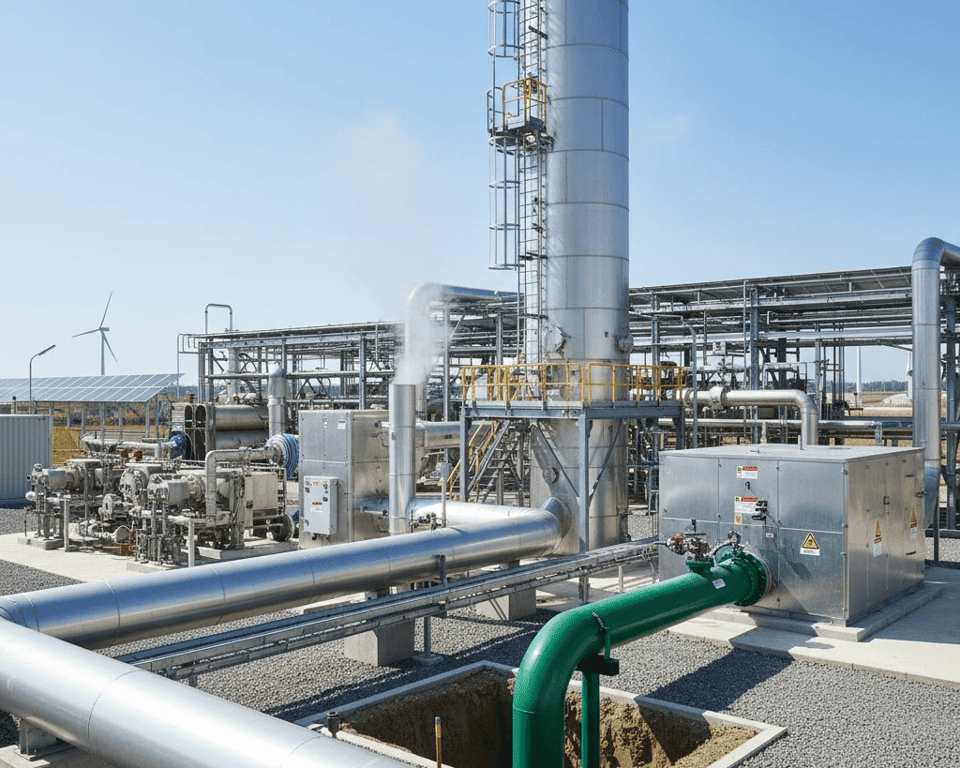
The Players Behind the Project
Bison Low Carbon Ventures is a private Alberta-based company founded in 2020. Its leadership team brings decades of experience from the upstream oil and gas sector, translating directly into subsurface expertise for CO2 sequestration.
Marubeni's investment came through a share subscription agreement signed in July 2023. The Japanese trading giant sees CCS as essential technology for decarbonizing industries where reducing emissions through conventional methods remains difficult. Their participation also opens doors for potential blue hydrogen and blue ammonia production in the region.

"Bison welcomes CMC participation in the early stages of development of the Meadowbrook Storage Hub. We hope CMC's experience with the Newell County Facility and the JIP's evolving strategies can be applied to a deep saline aquifer application."
Matthew Brister, President, Bison Low Carbon Ventures
How the Hub Will Scale
Bison plans to develop Meadowbrook in stages. The initial phase handles under 100,000 tonnes per year, but infrastructure is designed to grow with demand. The primary target market is Alberta's Industrial Heartland, the region northeast of Edmonton hosting refineries and petrochemical plants facing carbon pricing pressure.

A visual overview of the strategic phased development timeline. As of December 2025, the 'Initial Start-up' phase is active with a capacity under 100 kt/year. The roadmap outlines scaling to the fully licensed 500 kt/year target and a planned future expansion exceeding 3 Mt/year.
>> In Other News: ClimeFi Announces New 85,000 Tonne Procurement Round
Global Momentum for CCS
The Meadowbrook launch comes as global CCS investment accelerates. According to the IEA's World Energy Outlook 2025, CO2 captured globally is projected to grow from 43 million tonnes in 2024 to 300 million tonnes by 2050. For hard-to-abate sectors, permanent CO2 storage remains a critical piece of net-zero strategies.
What Comes Next
With Meadowbrook now operational, Bison is demonstrating the practical feasibility of CO2 injection at commercial scale. Marubeni and Bison have already signaled they want to accelerate discussions with CO2 emitters across the region.
The hub's success could influence how quickly the remaining 24 Alberta CCS tenures move toward development. Meadowbrook has set a template: navigating the regulatory process, building infrastructure, and beginning CO2 injection is achievable within a reasonable timeframe. Each tonne locked underground brings Alberta closer to its role as a North American leader in carbon management.
Subscribe to the newsletter
Daily decarbonization data and news delivered to your inbox
Follow the money flow of climate, technology, and energy investments to uncover new opportunities and jobs.
Latest issues
-
Who Bought Gevo’s $50M in 45Z Credits?
Inside This Issue ⛽ Gevo Sells $70M in 45Z Credits to a New Kind of Buyer 🌱 South Pole, Gaïago, and Gold Standard Issue European Soil Carbon Credits, Unlocking Verified Regenerative Agriculture Re...
-
Verra Landed CCP Approval. What Changes for DAC?
Inside This Issue ✅ Verra's CCS Credits Just Got the Integrity Seal Buyers Want 💰 South Korea Unveils $747 Billion Energy Transition Plan Through 2035 💧 Hydrogen and Carbon Capture and Storage in ...
-
Quebec Wood Waste Just Became Jet Fuel
Inside This Issue 🌲 ARC Bio Tests a Refinery Shortcut to Forest-Based SAF 💧 Scientists Just Found a New Way to Make Hydrogen from Water 🤝 How Channel Partnerships Are Helping More Organizations Ta...
Company Announcements
-
Mineral Europa: A Game Changer for Shipping
Antwerp, Oct. 09, 2026 (GLOBE NEWSWIRE) -- Antwerp, 9 October 2026 – CMB.TECH NV (“CMB.TECH” or the “Company”) (NYSE: CMBT, Euronext Brussels: CMBT and Euronext Oslo Børs: CMBTO) today announces th...
-
Download PDF (170.95 KB) Eni CCUS Holding, owned jointly by Eni and Global Infrastructure Partners ("GIP"), part of BlackRock, announces that Liverpool Bay CCS has completed the installation of th...
-
First-of-its-kind project in France and Belgium marks a major breakthrough for carbon credit buyers seeking high-integrity, high-impact regenerative agriculture removals in Europe; providing buyer...
-
Gevo and ClimeFi Complete Carbon Removal Transaction, Advancing Gevo's Growing Carbon Business
Transaction supports Gevo's path toward a carbon business exceeding $30 million in annual revenue from existing operations ENGLEWOOD, Colo., Oct. 08, 2026 (GLOBE NEWSWIRE) -- Gevo, Inc. (NASDAQ: G...